
Log In
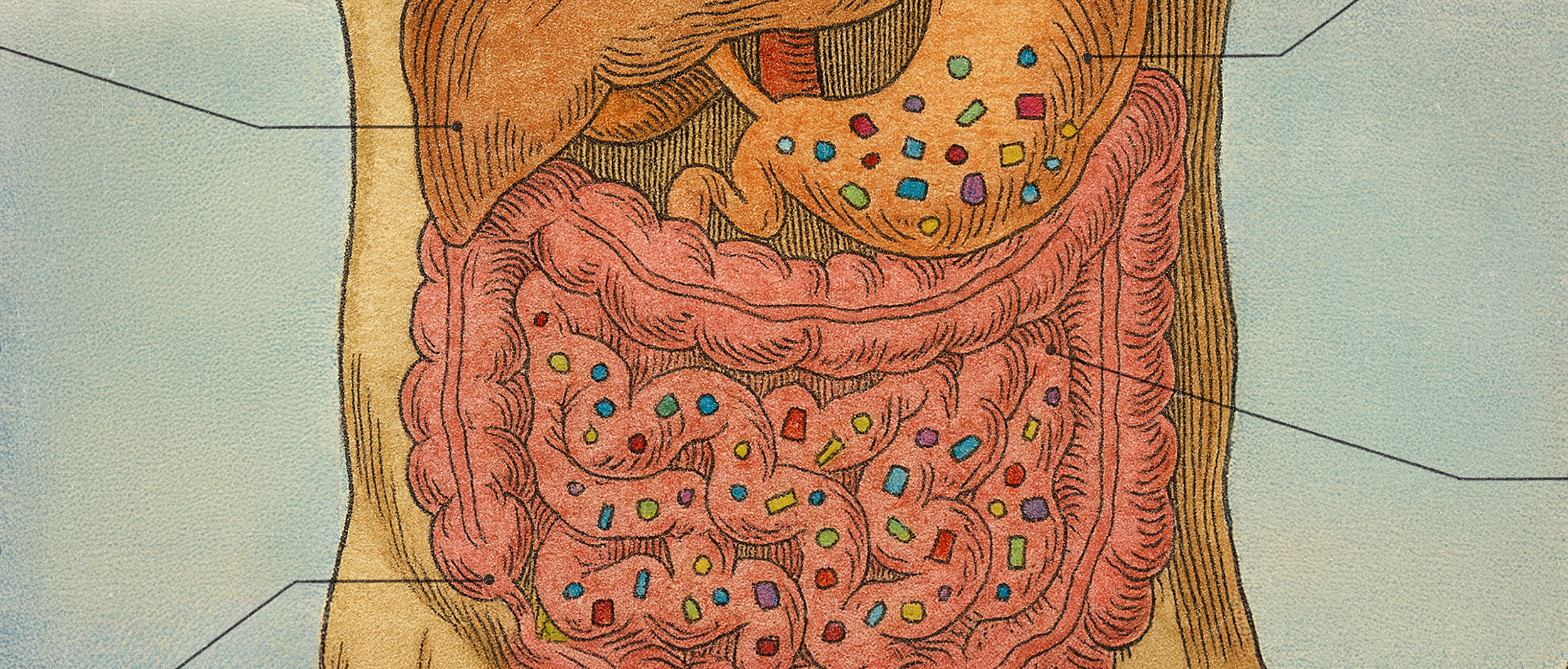
Microplastics are small plastic particles—typically less than 5 millimeters in size—resulting from the gradual breakdown of larger plastic items like bottles, packaging, and textiles. They persist in the environment, are ingested through air, food, and water, and may be related to a host of health-related issues.
Persistence and Exposure
Microplastics represent a complex class of pollutants, driven by enormous global production and disposal of plastics. Most are made from synthetic hydrocarbons like polyethylene, polystyrene, and polyvinyl chloride—materials that don’t decompose by design. Instead, ultraviolet radiation breaks molecular bonds, oxidation weakens surfaces, and physical abrasion grinds these polymers into ever-smaller fragments.
Progressive disintegration results in plastic particles that accumulate in the environment and food chain for decades – or even centuries.
Microplastics have become virtually impossible to avoid. They drift in the air, settle on crops and soil, wash into rivers and oceans, and circulate back into the food supply. Even food packaging can add to the load, as microscopic particles migrate from containers or are introduced during handling. Each sip of water, bite of food, or breath of air is another opportunity for exposure.
One analysis of U.S. exposure pathways estimated that adults ingest roughly 39,000 to 52,000 microplastic particles each year, rising to 74,000 to 121,000 when inhalation is included. Global estimates are highly variable and still provisional, but current reviews suggest humans may consume on the order of 0.1 to 5 grams of microplastics per week—roughly the mass of a credit card.
Potential Health Impacts
The biological effects of microplastics are not yet well-understood. Most evidence comes from laboratory and animal studies, which reveal plausible mechanisms of harm but not yet clear cause-and-effect relationships. Current research focuses on how these particles interact with tissues, trigger inflammation, and act as carriers for other environmental chemicals, as described below.
Reducing Exposure and its Effects
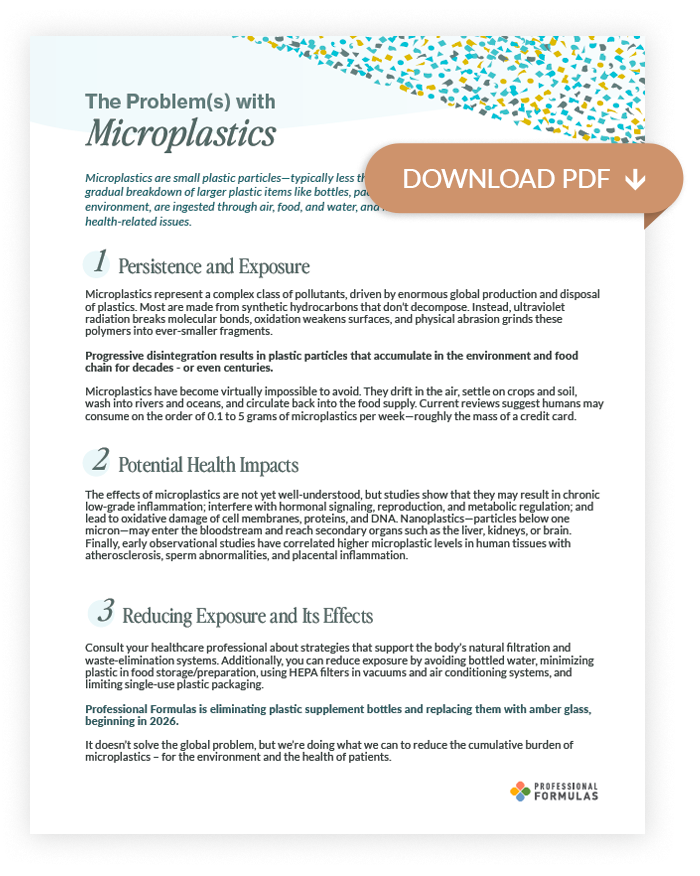
Complete avoidance of microplastics isn’t possible, so the goals are two-fold: supporting the body’s natural filtration and waste-elimination systems, and minimizing additional exposure.
Promote healthy filtration and waste elimination with nutrients that support liver flow and bile production, like methionine, cysteine, taurine, antioxidants (glutathione, vitamin C, NAC), and B-vitamins. Additionally, probiotics maintain microbial diversity and gastrointestinal integrity, while antioxidants and omega-3 fatty acids help support a healthy inflammatory status.
Minimize additional exposure with simple strategies like avoiding bottled water, minimizing plastic in food storage/preparation, using HEPA filters in vacuums and air conditioning systems, selecting natural or blended textiles, and limiting single-use plastic packaging.
Speaking of single-use plastic packaging, Professional Formulas – like all professional brands – has long relied on plastic bottles for our encapsulated supplements.
We’re eliminating plastic supplement bottles and replacing them with amber glass, beginning in 2026.
It doesn’t solve the global problem, but we’re doing what we can to reduce the cumulative burden of microplastics – for the environment and the health of patients.
Our new resource helps you educate patients about the issue – and what to do about it.
Hannah Ritchie, Veronika Samborska, and Max Roser (2023) – “Plastic Pollution” Published online at OurWorldinData.org. Retrieved from: ‘https://ourworldindata.org/plastic-pollution’.
Bessa F, Ratcliffe N, Otero V, et al. Microplastics in gentoo penguins from the Antarctic region. Sci Rep. 2019;9(1):14191. Published 2019 Oct 2. doi:10.1038/s41598-019-50621-2
Gruber, E.S., Stadlbauer, V., Pichler, V. et al. To Waste or Not to Waste: Questioning Potential Health Risks of Micro- and Nanoplastics with a Focus on Their Ingestion and Potential Carcinogenicity. Expo Health 15, 33–51 (2023). https://doi.org/10.1007/s12403-022-00470-8
Mohamed Nor, N. H., Kooi, M., Diepens, N. J., & Koelmans, A. A. (2021). Lifetime accumulation of microplastic in children and adults. Environmental science & technology, 55(8), 5084-5096.
Hernandez LM, Xu EG, Larsson HCE, Tahara R, Maisuria VB, Tufenkji N. Plastic Teabags Release Billions of Microparticles and Nanoparticles into Tea. Environ Sci Technol. 2019;53(21):12300-12310. doi:10.1021/acs.est.9b02540
Bello FA, Folorunsho AB, Chia RW, Lee JY, Fasusi SA. Microplastics in agricultural soils: sources, impacts on soil organisms, plants, and humans. Environ Monit Assess. 2025;197(4):448. Published 2025 Mar 21. doi:10.1007/s10661-025-13874-1
Bahrani F, Mohammadi A, Dobaradaran S, et al. Occurrence of microplastics in edible tissues of livestock (cow and sheep). Environ Sci Pollut Res Int. 2024;31(14):22145-22157. doi:10.1007/s11356-024-32424-9
da Silva Brito WA, Mutter F, Wende K, Cecchini AL, Schmidt A, Bekeschus S. Consequences of nano and microplastic exposure in rodent models: the known and unknown. Part Fibre Toxicol. 2022;19(1):28. Published 2022 Apr 21. doi:10.1186/s12989-022-00473-y
Rafa N, Ahmed B, Zohora F, et al. Microplastics as carriers of toxic pollutants: Source, transport, and toxicological effects. Environ Pollut. 2024;343:123190. doi:10.1016/j.envpol.2023.123190
Federal Institute for Risk Assessment (2024). “BfR-Verbrauchermonitor 08 | 2024.” Pdf (German)
Cart has been replaced
Enter the information below, and we’ll send your patient a link to order these products directly.
Want to share multiple products?
Add them to your cart and click Share Basket at checkout.
Enter the information below, and we'll send your patient a link allowing them to order it directly.
Sorry. You must be logged in to view this form.
Use the Share with a Patient button on any product page. Learn more about Patient Fulfillment here.
Unlock exclusive access to professional-quality supplements & homeopathic remedies.
Healthcare professionals get practitioner pricing and resources, and access to our full catalog.

Already have an account?
Log in here.